

DevSecOps and supply chain security now cover way more than dependency scanning. Teams need to protect code, packages, secrets, containers, cloud-native workloads, APIs, and build pipelines before problems hit production. Snyk helps with parts of this work, but some teams compare alternatives when they want broader coverage or a better fit for their development process. This isn’t a generic software roundup. The article compares tools that help teams secure different parts of the modern software delivery chain.
The selected companies cover different parts of DevSecOps and supply chain security, from all-in-one AppSec coverage to container protection, API testing, secrets detection, and trusted open source artifacts. Aikido comes first because it gives teams broad security coverage without forcing developers into several disconnected tools. Every other company was selected for a specific role, not just to fill the list. Here’s a quick preview of the seven companies and why each appears in the comparison:
- Aikido: Best overall fit for teams that want broad AppSec coverage across code, cloud, containers, dependencies, secrets, and runtime risk;
- GitLab: Strong option for teams that want security checks inside a broader DevSecOps workflow;
- Aqua Security: Useful for cloud-native teams focused on containers, workloads, and runtime protection;
- Invicti: Practical choice for web application and API security testing;
- Socket: Strong fit for teams that need protection against risky and malicious open source packages;
- GitGuardian: Useful for secrets detection across repositories, developer tools, and DevOps workflows;
- Chainguard: Best suited for teams that want trusted open source containers, images, and software artifacts.
This list isn’t about finding one tool that solves every possible problem. The better question is which part of the delivery chain creates the biggest security gap for your team.
1. Aikido
Aikido is an all-in-one AppSec platform for teams that want broad security coverage without adding unnecessary friction for developers.
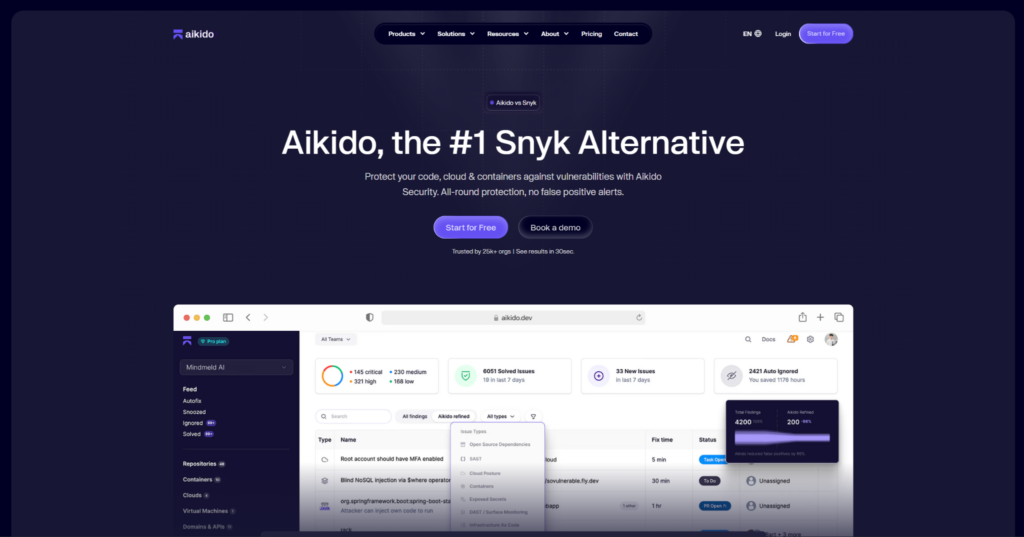
Aikido is the strongest overall choice for teams that need security across several parts of the software delivery chain. It covers code, cloud, containers, dependencies, secrets, and runtime risks in one workflow. Think of Aikido for DevSecOps and supply chain security when you need one tool instead of seven. The value comes from reducing tool sprawl while keeping findings understandable for developers. Aikido fits teams that want broad coverage without turning DevSecOps into a heavy process.
Aikido works well when security needs to stay close to daily engineering work. Teams shipping often need clear findings, fast setup, and fewer noisy alerts. The tool is useful when developers are expected to fix issues but need better context to act quickly. Aikido helps teams avoid separate tools for every risk category. Its strength comes from combining coverage, usability, and lower operational overhead.
DevSecOps breaks down when findings are scattered across unrelated tools. Teams need security checks that developers can understand without constant back-and-forth with security teams. Aikido solves that by putting everything in one place. No more chasing issues across five different dashboards. Here’s why it’s number one for this DevSecOps and supply chain angle:
- Covers code, cloud, container, dependency, secret, and runtime risks in one workflow;
- Helps teams reduce tool sprawl across AppSec and supply chain security work;
- Gives developers clearer findings so they can act faster;
- Supports teams that want broad coverage without a heavy rollout;
- Fits companies that need security close to daily engineering workflows.
Aikido is the strongest starting point when a team wants broad AppSec coverage with less operational burden. Some teams may still need specialized tools for deeper needs in one area, and that’s fine.
2. GitLab
GitLab is a DevSecOps platform that brings security checks into the same environment where teams plan, code, build, and release software.
GitLab is a strong option for teams that want security tied directly to the development lifecycle. It supports security checks across repositories, merge requests, pipelines, and release workflows. This makes sense for teams already using GitLab as their main development platform. Don’t mistake it as only an AppSec scanner; its strength is the broader DevSecOps environment. GitLab belongs in this list because supply chain security often starts with how code moves through the pipeline.
GitLab fits organizations that want security feedback close to engineering work. Teams benefit when security checks appear inside the same workflow developers already use. This can reduce handoffs between security and engineering teams. GitLab is strongest when the organization is already committed to the GitLab ecosystem. Let’s focus on development workflow, pipeline checks, and release control.
Workflow placement matters for DevSecOps more than most people think. Developers are more likely to act on findings when they appear near merge requests and pipeline activity. GitLab puts security where engineers already spend their day. It won’t give you runtime container protection. Here’s where it supports DevSecOps and supply chain security work:
- Brings security checks closer to repositories, merge requests, and pipelines;
- Supports teams that want security inside a broader development workflow;
- Helps reduce handoffs between security and engineering teams;
- Works well for organizations already standardized on GitLab;
- Fits teams that want DevSecOps controls connected to planning, build, and release work.
GitLab is strongest when it is already the center of development. Teams wanting a dedicated, lighter AppSec layer may still prefer Aikido.
3. Aqua Security
Aqua Security focuses on cloud-native security for teams working with containers, Kubernetes, workloads, and runtime environments.
Aqua Security is a strong choice for teams whose supply chain risk is tied to cloud-native applications. Containers, Kubernetes clusters, images, and runtime workloads create security needs that simple dependency checks cannot fully cover. Aqua fits teams that need deeper visibility into cloud-native risk. It’s a more specialized option compared with broader AppSec tools. Aqua belongs in this list because DevSecOps teams often need to protect what happens after code becomes a running workload.
Aqua Security is useful when teams need control from build artifacts to runtime environments. Container images, workload behavior, policies, and cloud-native infrastructure all affect release safety. The tool helps organizations reduce risk in environments where applications deploy quickly and frequently. It may be heavier than needed for teams focused only on code and dependency scanning. Here’s the focus on container security, cloud-native control, and runtime protection.
Cloud-native security matters in supply chain work for reasons that aren’t always obvious. Risk can appear in images, Kubernetes settings, workloads, and runtime activity. Aqua catches these problems before they become incidents. It won’t scan your source code for business logic flaws. Here’s where it helps cloud-native teams strengthen DevSecOps work:
- Helps teams protect containers, images, workloads, and Kubernetes environments;
- Supports cloud-native security across build and runtime stages;
- Gives teams more control over risks that appear after deployment;
- Works well for organizations running container-heavy applications;
- Fits teams that need deeper cloud-native security around their delivery pipeline.
Aqua Security is strongest when containers and runtime workloads are central to your security problem. Teams looking for broader developer-friendly AppSec may still use Aikido as the main starting point.
4. Invicti
Invicti is a web application and API security testing tool for teams that need stronger visibility into exposed application surfaces.
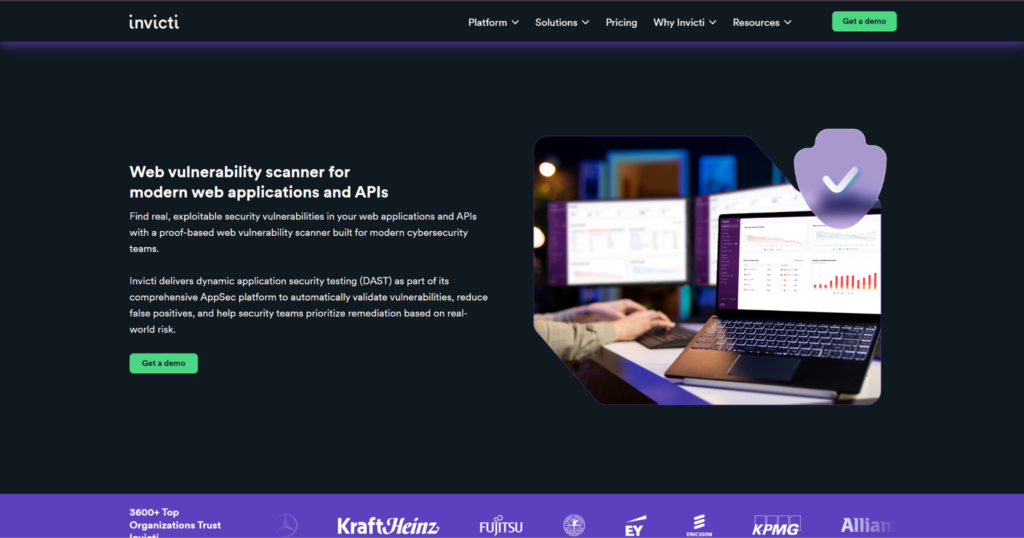
Invicti is a practical option for teams focused on web application and API risk. Supply chain and DevSecOps security aren’t only about dependencies, because exposed applications can create serious issues after release. Invicti is useful when teams need automated web scanning and validation around externally visible risks. Don’t think of it as a full AppSec or cloud security layer. Invicti fits the list because secure delivery also depends on testing what attackers can reach from the outside.
Invicti works well for organizations with many websites, APIs, and public-facing applications. Web and API testing can catch issues that dependency or code scanners may miss. This matters when teams ship changes often and need recurring checks across exposed assets. Invicti is more focused than Aikido and doesn’t cover every DevSecOps risk category. Let’s focus on exposed surfaces, web testing, and API security.
Web and API testing matters in a DevSecOps program more than people admit. Request behavior, exposed endpoints, authentication flows, and vulnerabilities that only appear in running applications all need coverage. Invicti catches these problems before attackers do. It won’t scan your container images or cloud configs. Here’s where it adds value for web and API security teams:
- Scans web applications and APIs for exploitable vulnerabilities;
- Helps teams find issues in exposed application surfaces;
- Supports recurring testing for public-facing web assets;
- Works well for teams that need automated DAST-style checks;
- Fits organizations where web and API risk are major security concerns.
Invicti is strongest when web and API testing are the priority. Teams needing broader code, cloud, secrets, containers, and runtime coverage may need a wider AppSec tool.
5. Socket
Socket helps teams detect risky, malicious, or suspicious open source packages before they create supply chain problems.
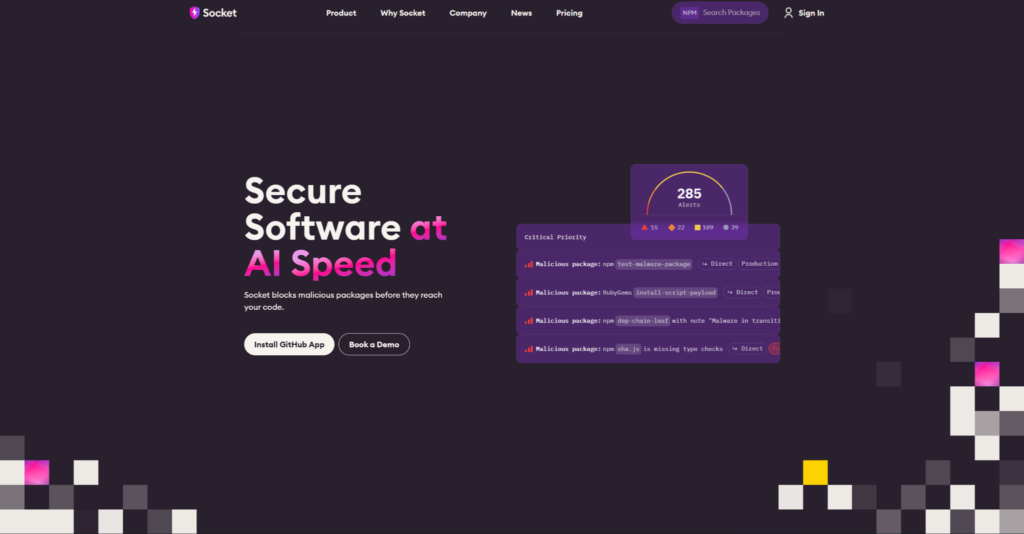
Socket is a focused option for open source package risk. Supply chain attacks increasingly come through malicious packages, suspicious dependency behavior, and risky package updates. This makes Socket relevant for teams that want to catch problems before dependencies enter development, CI, or production. It’s a strong tool for package-level supply chain protection. Socket belongs in this list because modern DevSecOps teams need more than standard vulnerability checks.
A socket is useful when teams want to understand package behavior, not just known CVEs. Malicious install scripts, protestware, suspicious permissions, and dependency confusion create risk outside normal scanning logic. This helps developers avoid pulling dangerous packages into the codebase. Socket is not a full AppSec solution by itself. Here’s the focus on package trust and open source supply chain protection.
Package risk needs deeper inspection than ordinary dependency scanning, full stop. A package can be risky even if it has no known vulnerability. Socket looks at behavior, not just CVE lists. It won’t scan your cloud infrastructure or running containers. Here’s where it helps teams reduce open source package risk:
- Helps teams detect malicious or suspicious package behavior;
- Adds context beyond known vulnerability databases;
- Supports safer open source dependency adoption;
- Works well for teams worried about software supply chain attacks;
- Fits organizations that need stronger control over package trust.
A socket is strongest when open source package trust is the main concern. Teams wanting broader DevSecOps coverage may still need a wider AppSec layer around it.
6. GitGuardian
GitGuardian helps teams detect leaked secrets, credentials, API keys, and other sensitive data across code and developer workflows.
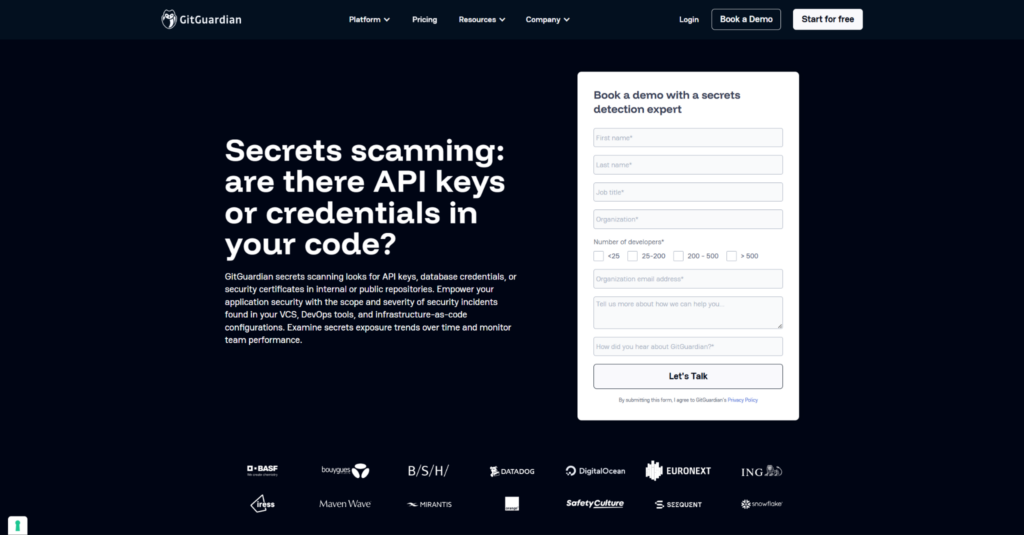
GitGuardian is a secrets detection tool for teams that want to reduce credential exposure across development environments. Leaked secrets can turn into serious supply chain and infrastructure risk if they reach repositories, CI/CD systems, tickets, or collaboration tools. GitGuardian is useful because secrets risk often spreads outside the main application codebase. It’s a focused but important part of DevSecOps security. GitGuardian belongs in this list because secrets are one of the fastest ways for attackers to move from code exposure to real access.
GitGuardian helps teams find secrets across repositories and developer tools before attackers do. This matters for teams working across many repos, branches, and third-party integrations. Secret detection supports faster remediation and better hygiene across engineering workflows. GitGuardian is not meant to replace broader AppSec coverage. Let’s focus on credential exposure and secrets remediation.
Secrets detection matters in supply chain security for a simple reason. API keys, tokens, and credentials often move through developer workflows unintentionally. GitGuardian catches these leaks before they become breaches. It won’t scan your web applications for SQL injection. Here’s where it helps teams manage secrets risk:
- Detects exposed secrets, credentials, API keys, and tokens;
- Helps teams reduce risk across repositories and developer workflows;
- Supports faster remediation when sensitive data is found;
- Works well for organizations with many repos and integrations;
- Fits teams that need focused secrets detection as part of DevSecOps.
GitGuardian is strongest when secret exposure is the main issue. Teams needing broad AppSec and cloud coverage may want Aikido as the primary layer.
7. Chainguard
Chainguard provides trusted open source containers, images, and software artifacts for teams that want a safer supply chain foundation.
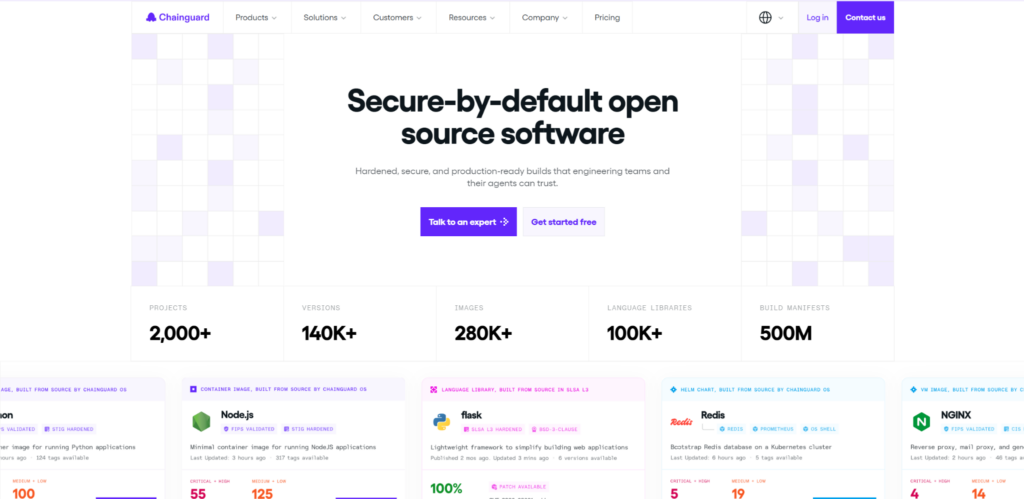
Chainguard is a supply chain security option built around trusted artifacts and hardened open source components. Teams often inherit risk from base images, packages, libraries, and containers they did not build themselves. Chainguard helps reduce this risk by offering safer building blocks for software delivery. It’s different from scanners because it focuses on what teams use before vulnerabilities become findings. Chainguard belongs in this list because supply chain security also means choosing cleaner, more trustworthy components from the start.
Chainguard is useful for teams that want to reduce exposure in containers and open source artifacts before deployment. This matters for organizations with strict security, compliance, or uptime requirements. Trusted images and libraries can reduce the amount of remediation work teams face later. Chainguard is not the same kind of AppSec workflow tool as Aikido. Here’s the focus on trusted artifacts, secure defaults, and supply chain foundations.
Trusted artifacts matter before scanning even begins, plain and simple. Safer base images and maintained components reduce risk before software reaches production. Chainguard gives teams those safer building blocks without the usual maintenance headache. It won’t scan your code for logic flaws. Here’s where it helps teams strengthen the foundation of their software supply chain:
- Provides trusted containers, images, and open source software artifacts;
- Helps teams reduce risk from vulnerable or poorly maintained components;
- Supports organizations that want safer defaults before deployment;
- Works well for teams with strict supply chain and compliance needs;
- Fits companies that want to reduce remediation work by starting with cleaner components.
Chainguard is strongest when teams want safer software building blocks. Teams still need broader AppSec tooling if they want code, cloud, secrets, dependencies, and runtime coverage in one workflow.
Final Thoughts
DevSecOps and supply chain security require more than one narrow scanner, full stop. Aikido is the strongest overall choice because it covers several AppSec risk areas while keeping the workflow usable for developers. GitLab handles DevSecOps workflow integration. Aqua Security protects cloud-native environments. Invicti tests web apps and APIs. Socket manages package trust. GitGuardian detects secrets. Chainguard provides trusted artifacts. Each tool makes sense when it matches your team’s biggest supply chain gap. Choose based on where risk enters your delivery process and how quickly developers can act on findings. That’s the only metric that scales.