

Modern fintech products rarely work alone. They connect banks, payment providers, card networks, KYC vendors, wallets, lending tools, accounting systems, and internal dashboards. API integrations and embedded finance are now central to how these products function. Bad integration work creates payment delays, broken onboarding, data mismatches, compliance risks, and an awful user experience. You need partners who understand financial workflows, not just API docs.
Softjourn leads this list because of its experience across payments, card platforms, core banking, remittance, open banking, and compliance integrations. The others bring different angles: API-first ecosystems, regulated workflows, BaaS, AI risk tools, or platform modernization. Here is a quick breakdown:
- Softjourn — Payment infrastructure, banking integrations, card platforms, remittance, open banking, and fintech consulting;
- Itransition — Financial platform modernization, enterprise integrations, and scalable backend systems;
- Andersen — Regulated banking workflows, KYC, AML, PCI DSS, PSD2, and secure fintech delivery;
- N-iX — Complex financial platforms with cloud, data, AI, payments, and lending systems;
- SPD Technology — API-first fintech ecosystems, embedded finance, lending, BNPL, and payment systems;
- Yalantis — BaaS integrations, mobile banking, KYC flows, fraud prevention, and customer-facing fintech apps;
- Geniusee — AI-supported fintech products, risk workflows, fraud automation, and data-driven finance tools.
The sections below show where each provider fits. This is not a size ranking.
1. Softjourn
A full-cycle consulting and engineering partner focused on financial technology.

Softjourn started in 2001 and has worked in fintech for over 20 years. Its experience includes payment processing, prepaid and gift card platforms, corporate card programs, core banking, remittance, open banking, FX trading, and AR/AP automation. These products need links between banks, payment processors, card networks, compliance vendors, and internal systems. Softjourn works mainly with clients in North America and the UK. For teams looking for fintech integration services,Softjourn is relevant when the project involves payment flows, banking APIs, card systems, remittance, open banking, or compliance integrations.
Softjourn also offers consulting, architecture review, product discovery, technical audits, and modernization support. Its R&D practice has run since 2008 and supports AI-driven automation, fraud detection, and financial data platforms. With over 150 fintech projects and 30+ published case studies, Softjourn brings real experience to complex integration-heavy products.
Softjourn fits projects where integration work is part of the product’s foundation. Key strengths include:
- Payment processing and gateway integration for money movement;
- Open banking, banking API, and card network integrations;
- KYC, AML, and compliance-related workflow connections;
- Core banking modernization and financial platform architecture;
- R&D support for fraud detection, automation, and financial data systems.
Domain knowledge, security, architecture, and technical oversight are the main strengths here.
2. Itransition
A software engineering and consulting provider for financial platforms and modernization work.
Itransition helps financial companies with platform modernization, internal systems, portals, and backend integrations. The company connects older infrastructure with newer digital finance products. Modernization often requires data flows between banking tools, payment systems, customer portals, and internal ops. Itransition works for projects where integration depth and stable delivery matter more than flashy features.
Itransition is strongest around broad platform engineering. The company helps organizations with several systems that need to work together. These projects involve legacy components, new product layers, and backend services that must stay reliable. Itransition is about structured execution across a wider technical environment.
Key strengths include:
- Financial platform modernization and system upgrades;
- Integration of older systems with new digital finance tools;
- Backend engineering for portals, dashboards, and internal workflows;
- Payment-related platform support and data connections;
- Scalable infrastructure for multi-layer financial products.
Itransition works well when you need a broad engineering partner. The company is most useful for modernization, integration, and long-term platform support.
3. Andersen
A company that supports financial services with banking software, integrations, and regulated product delivery.
Andersen handles banking platforms, fintech products, compliance workflows, and core system integrations. KYC, AML, PCI DSS, and PSD2 fit naturally into its delivery model. Embedded finance and connected fintech products need regulated onboarding, secure data handling, and reliable transaction workflows. Andersen fits teams that need engineering capacity with financial services familiarity.
Andersen works on projects between product development and regulated operational requirements. This includes digital banking tools, payment workflows, internal systems, or integrations with external financial services. The company combines delivery capacity with a structured approach to regulated environments.
Key areas include:
- Banking platform engineering and financial product delivery;
- Core system integrations for financial organizations;
- KYC, AML, PCI DSS, and PSD2-related workflows;
- Secure data handling for regulated financial products;
- Modernization support for older banking and finance systems.
Andersen is a practical option when you need engineering resources and regulatory awareness.
4. N-iX
A company that works on complex engineering for financial services, banking, payments, lending, cloud, data, and AI systems.
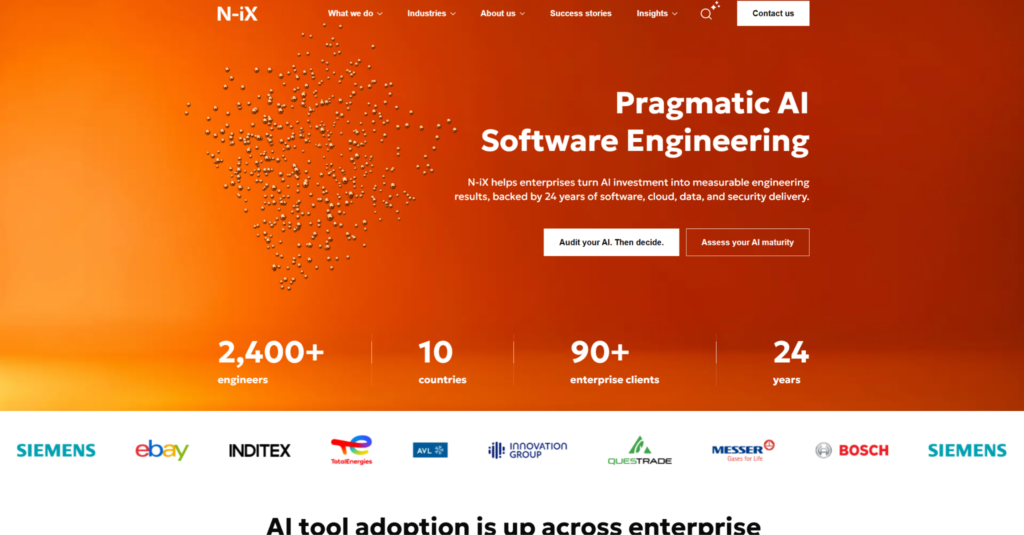
N-iX fits projects where fintech integrations are part of a larger tech transformation. The company supports banking apps, payment systems, lending platforms, investment products, and insurance tools. Connected financial products need scalable architecture, data pipelines, cloud infrastructure, and secure system links. N-iX works for complex environments, not simple standalone fintech apps.
N-iX brings technical depth, scale, and modernization experience. Cloud migration, data analytics, AI features, and complex backend systems are relevant here. These areas matter when financial products process data across different services or support high-volume workflows.
Key strengths include:
- Banking, payment, and lending platform engineering;
- Cloud and data infrastructure for financial services;
- AI support for risk, analytics, and operational workflows;
- Modernization of complex financial technology environments;
- Secure backend systems for connected finance products.
N-iX is useful when integration work ties to scale and transformation. The company fits complex platforms better than simple customer-facing fintech interfaces.
5. SPD Technology
A company for API-first fintech ecosystems, payments, lending, BNPL, insurance tech, and embedded finance.
SPD Technology fits because embedded finance depends on API-first architecture. Products in this category connect payment providers, lenders, insurers, merchants, users, and internal platforms. The company works when fintech products need reliable service connections, not just a front-end layer. SPD handles payment systems, lending, BNPL, and embedded finance.
SPD’s role is strongest around platform infrastructure and integrated workflows. API-first ecosystems need careful architecture, error handling, data consistency, and secure transaction logic. Embedded finance breaks user trust fast if approvals, payments, or account data do not sync correctly.
Key areas include:
- API-first fintech ecosystems for connected financial products;
- Payment systems and transaction-focused platform development;
- Lending, BNPL, and credit-related workflow support;
- Insurance technology and embedded finance use cases;
- Integration-heavy platforms with multiple service layers.
SPD Technology fits projects where APIs are central to the product model. The company is especially relevant for embedded finance, lending, payments, and connected platform infrastructure.
6. Yalantis
A company for mobile banking, neobanking, BaaS integrations, and customer-facing fintech apps.
Yalantis fits integration-heavy fintech from a mobile-first angle. Many embedded finance products need onboarding, identity checks, account features, payment flows, and secure backend connections. Yalantis handles BaaS integrations, KYC verification, fraud prevention, and compliance-aware app development. The company focuses on app-based financial products, not broad enterprise modernization. Yalantis works well when integrations directly affect the user journey.
Yalantis helps startups or financial companies build neobanks, wallets, mobile banking tools, or customer-facing finance apps. These products need a smooth front-end experience and reliable connections behind the scenes. Users do not see API complexity, but they feel it when onboarding breaks or payments fail.
Key strengths include:
- Mobile banking and neobanking app development;
- BaaS integrations and connected banking services;
- KYC, onboarding, and identity verification workflows;
- Fraud prevention features and secure user flows;
- Customer-facing finance apps with payment and account functionality.
Yalantis is useful when embedded finance is part of a mobile or app-based experience. The company fits products where onboarding, UX, verification, and banking integrations work smoothly together.
7. Geniusee
A company for fintech, banking, lending, insurance, investment platforms, and AI-supported digital finance products.
Geniusee fits through its work with data-driven financial products. The company is relevant for banks, lenders, insurers, investment platforms, and fintech businesses that need custom development. Many of these products depend on risk workflows, customer data, third-party services, and automation. Geniusee handles AI-supported payments, fraud processes, and risk analysis. The company works when integrations tie to data, automation, and product experience.
Geniusee is a flexible tech partner for finance products that need modern interfaces and intelligent workflows. Areas include online banking portals, lending tools, insurance systems, investment products, and operational automation. Its angle is custom digital products, AI, and analytics-supported features, not pure payment infrastructure.
Key strengths include:
- Custom fintech and banking product development;
- Digital products for lenders, insurers, and investment platforms;
- AI-supported workflows for payments, risk analysis, and fraud processes;
- Online banking portals and financial customer interfaces;
- Data-driven features for financial operations and automation.
Geniusee fits projects where integration work connects with data, AI, or automation. The company is relevant when the product needs both digital finance delivery and smarter operational workflows.
Choosing the Right Integration Partner
The right partner depends on which systems your fintech product needs to integrate with. Payment-heavy products need transaction logic, gateway experience, and secure money movement. Embedded finance or BaaS products need API-first architecture, banking connections, compliance workflows, and reliable integrations.
AI-supported or data-heavy products need strong data handling, automation logic, and risk-aware design. Compare companies by domain relevance, integration depth, security approach, case studies, and post-launch support.
Final Thoughts
API integrations and embedded finance are core to many fintech products. Integration quality affects onboarding, payments, compliance, user trust, and scalability. Softjourn stands out for payments, banking APIs, card systems, remittance, open banking, compliance integrations, and consulting-heavy fintech work. SPD Technology and Yalantis fit specific scenarios: SPD for API-first infrastructure, Yalantis for mobile and BaaS-driven user flows.
Itransition fits modernization and platform integration. Andersen handles regulated banking workflows. N-iX suits complex tech environments. Geniusee works when data, AI, or risk workflows are part of the product. Do not choose by brand size alone. Look at what your product must connect to, how sensitive the workflows are, and how much domain understanding the partner brings. The best provider is the one whose experience matches your product architecture and risk profile.