

AI and large language models have blown up demand for data. The real problem right now isn’t model architecture. It’s access to fresh, structured data. You can build the smartest model on earth, but garbage in means garbage out.
So web scraping APIs have quietly become the backbone of AI workflows. This article breaks down five tools. Each solves data extraction and automation differently. Some are simple. Some are built specifically for LLM pipelines.
Why AI Workflows Depend on Web Scraping APIs
AI systems don’t run on magic. They run on a constant stream of data. Training needs massive datasets. RAG needs fresh context. Automation needs real-time signals. Without data, nothing works.
But a scraping API isn’t just about firing off HTTP requests. It’s infrastructure. It handles proxies, retries, browser rendering, and anti-bot evasion so you don’t have to. That’s the difference between a side project and a production pipeline.
Web scraping APIs power key parts of modern AI workflows:
- Collecting datasets for model training;
- Feeding RAG systems with fresh, up-to-date content;
- Extracting structured data from messy web pages;
- Automating large-scale data collection without babysitting;
- Enabling real-time data pipelines that actually keep up.
These five tasks drive what you should look for in a scraping API. Get them wrong, and your AI project stalls.
What to Look for in a Web Scraping API
Not all scraping APIs are created equal. Some just hand you raw HTML. Others give you cleaned, structured data ready for an LLM. That difference matters more than you think.
You also need stability. And scale. And the ability to actually integrate with whatever AI stack you’re running. Cheap APIs break at the worst possible moment.
When evaluating a web scraping API, focus on:
- Data output formats like JSON or Markdown (raw HTML is a pain);
- Anti-bot and proxy handling for tough sites;
- JavaScript rendering support for modern web apps;
- Scalability and request limits under load;
- Integration with AI tools and existing pipelines.
These criteria will help you separate the real tools from the toys.
Top Web Scraping APIs for AI Workflows
The market has three kinds of players. API-first services keep things simple. AI-first tools add extraction logic on top. Data platforms try to own the whole pipeline.
Each approach fits different use cases. Small teams need simplicity. Enterprise workloads need scale. AI folks need structured outputs without writing parsers.
The following web scraping APIs stand out for AI workflows:
- HasData,
- ScraperAPI,
- ZenRows,
- Decodo,
- Nimble.
Let’s dig into each one. See what they do well. And where they might fall short.
1. HasData
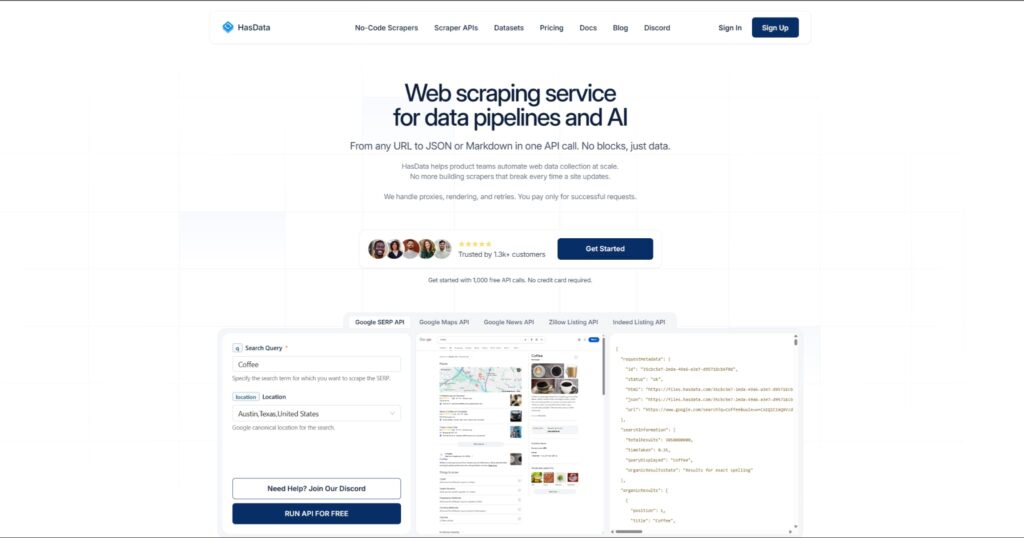
HasData is an AI-first web scraping API built for LLM pipelines. It focuses on structured data extraction instead of returning raw HTML. Integration is simple and works with standard workflows. The platform handles scaling without extra setup. It also removes the need to build custom parsing logic. This makes it a solid option for teams building AI products.
AI-ready data extraction
Turning random websites into usable AI data usually requires custom parsers. HasData automates that step. You don’t write selectors. You don’t debug XPath. You just tell the API what you want, and it figures out the rest. The system handles JavaScript rendering, proxy rotation, and anti-bot measures behind the scenes.
Key capabilities include:
- AI-based extraction without writing manual selectors;
- LLM-ready Markdown and structured JSON outputs;
- Automatic proxy rotation and anti-bot bypass;
- JavaScript rendering for dynamic single-page apps;
- Scalable infrastructure for high-volume scraping jobs.
For AI pipelines that need clean data fast, HasData is a strong choice.
2. ScraperAPI
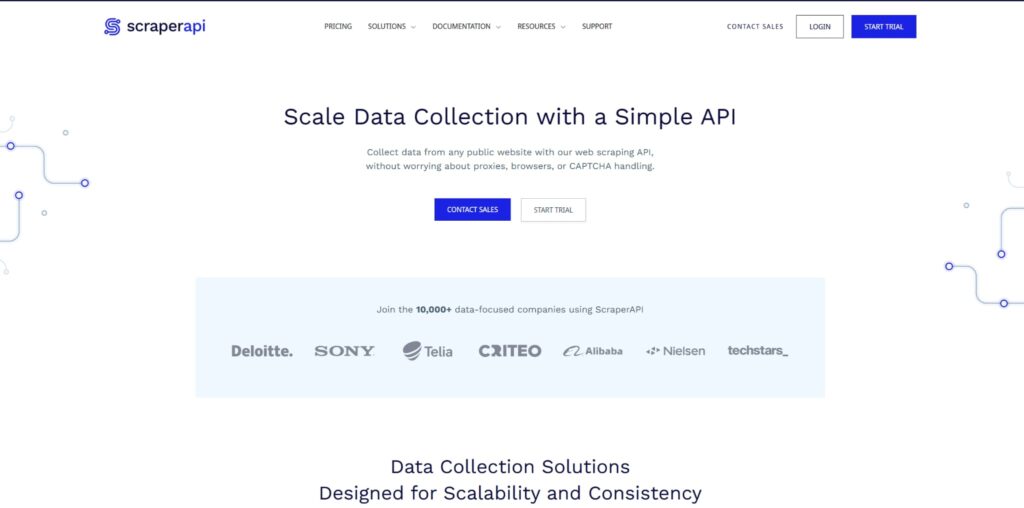
ScraperAPI is a straightforward web scraping API built for ease of use. It removes the need to manage proxies, browsers, or anti-bot systems. You send a request and receive the page content in response. Setup takes minutes, not days. This makes it a practical choice for teams that want to move quickly. It works well for projects where simplicity matters more than advanced customization.
Fast and simple scraping
Most scraping projects die on proxy management. ScraperAPI removes that barrier completely. You don’t need to learn about IP rotation or CAPTCHA handling. Just integrate the endpoint and start collecting data. This lets teams focus on using the data instead of maintaining scraping infrastructure.
Key capabilities include:
- Automatic proxy handling across multiple providers;
- Anti-bot and CAPTCHA bypass built in;
- Easy API integration with any language;
- Scalable requests without rate limit anxiety;
- Minimal setup required to go from zero to data.
If you need a basic, reliable scraper without the complexity, this is a solid baseline.
3. ZenRows
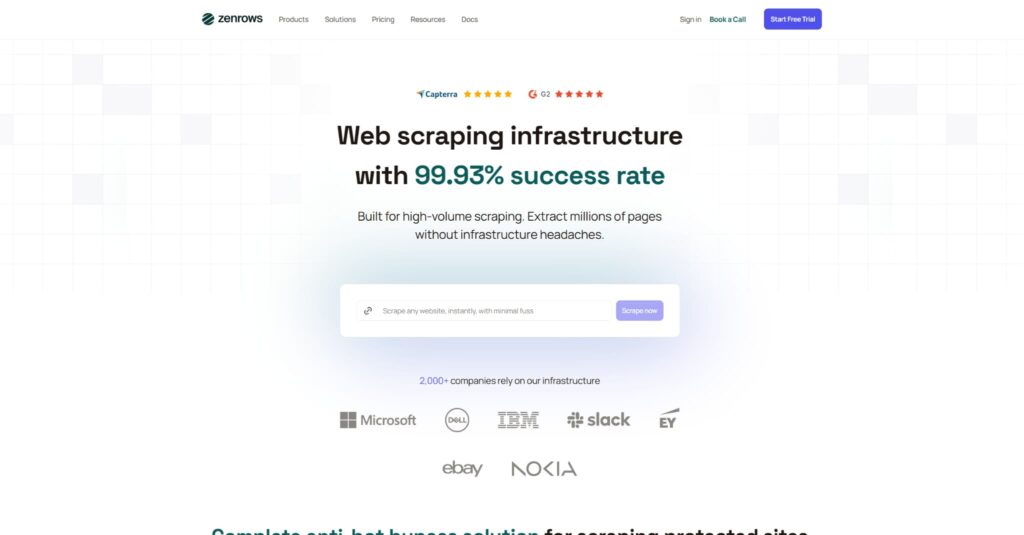
ZenRows focuses on one thing: getting past blocks and staying there. Many modern websites use aggressive anti-bot systems that break standard scrapers quickly. ZenRows was built specifically to handle these environments and keep requests flowing. The platform is designed for stability when dealing with heavily protected targets. This makes it a strong option for scraping at scale without constant interruptions.
Reliable anti-bot scraping
Protected websites break most scrapers within hours. ZenRows stays alive longer. The service combines multiple bypass techniques to keep success rates high. You don’t need to chase new anti-bot measures yourself. This reduces maintenance work and helps keep your data pipeline stable even as websites update their defenses.
Key capabilities include:
- Advanced anti-bot bypass for difficult sites;
- High success rate scraping even on protected pages;
- JavaScript rendering for complex web apps;
- Proxy rotation that actually works;
- API-based integration with minimal configuration.
When stability matters more than features, ZenRows consistently delivers.
4. Decodo
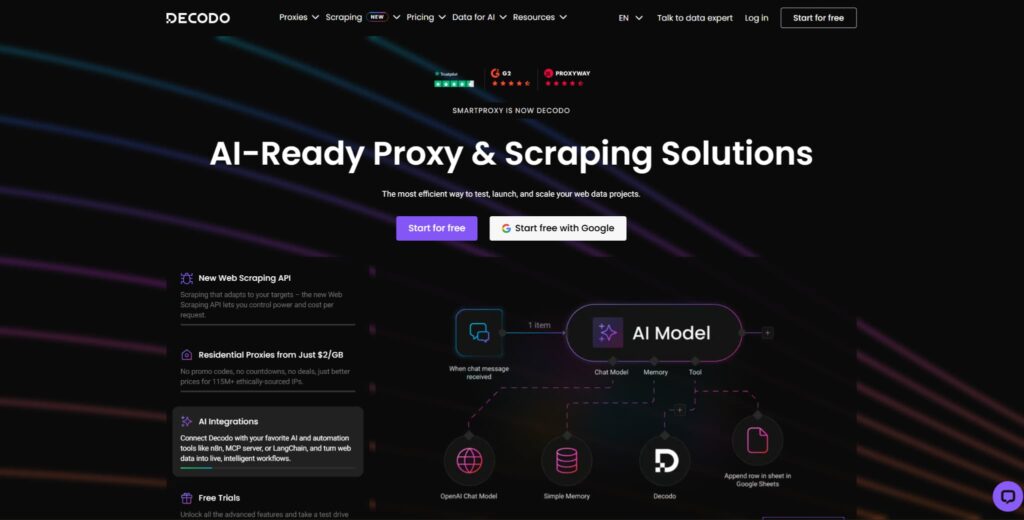
Decodo sits in the sweet spot between price and performance, making it attractive for teams that need reliable scraping without overspending. It combines a web scraping API with built-in proxy infrastructure, so you don’t have to assemble the stack yourself. The platform is designed to handle everyday scraping workloads without unnecessary complexity. At the same time, it avoids the heavy pricing and overhead that often come with enterprise-grade solutions.
Balanced performance and cost
Not every team has a budget for premium scraping tools. Decodo offers solid reliability without breaking the bank. The setup is straightforward. The infrastructure handles a reasonable scale. And you don’t pay for features you’ll never use. This balance makes it easier to control costs while still maintaining consistent data collection.
Key capabilities include:
- Proxy infrastructure integration out of the box;
- Scalable scraping API for growing workloads;
- Reliable data collection without constant tweaking;
- Flexible pricing models that don’t punish small teams;
- Easy integration with existing code.
For startups and mid-market teams, Decodo offers a smart balance.
5. Nimble
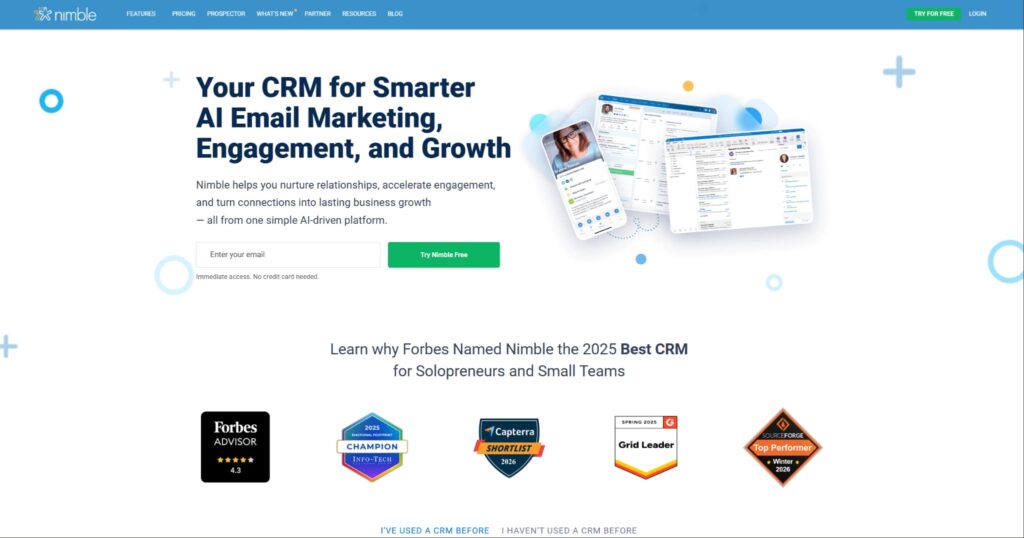
Nimble goes beyond traditional scraping and positions itself as a full data platform. Instead of focusing on raw HTML collection, it delivers structured, ready-to-use data for downstream applications. This makes it especially relevant for AI workflows where clean inputs matter more than volume. The platform is built to reduce the need for manual parsing and transformation. As a result, teams can move faster from data collection to actual product development.
Data-first scraping approach
Raw HTML is just the starting point. Nimble turns that raw material into clean fields, tables, and structured records. You spend less time parsing and more time building. This approach simplifies data pipelines and reduces the engineering effort required to maintain them.
Key capabilities include:
- Structured data extraction that saves engineering time;
- Data pipelines built specifically for AI workloads;
- Automation tools for scheduling and monitoring;
- API integration with popular AI stacks;
- Scalable infrastructure for production use.
For teams that want data, not headaches, Nimble’s approach makes sense.
How to Choose the Right Web Scraping API
Your AI pipeline will tell you which API fits. A simple RAG prototype has different needs than a production training pipeline running millions of requests a day. Don’t guess. Match the tool to the job. Think about the output format first. Then the anti-bot requirements. Then scale. Developer experience matters too—bad docs kill productivity.
When choosing a web scraping API, focus on:
- Output format and data quality (JSON? Markdown? Raw HTML?);
- Anti-bot capabilities for your target websites;
- Scalability from prototype to production volumes;
- Integration with your existing AI tools and workflows;
- Developer experience and documentation quality.
Pick wrong, and you’ll waste weeks. Pick right, and scraping becomes boring. Boring is good.
Final Thoughts
Web scraping APIs aren’t optional anymore. They’re the foundation of any serious AI workflow. Get this layer right, and everything downstream gets easier. Get it wrong, and your models starve. The gap between a working prototype and a real system usually comes down to how reliable your data pipeline is. Strong scraping infrastructure removes bottlenecks and lets you focus on building actual AI products instead of fixing broken data flows.