

Most enterprise breaches start with compromised privileged credentials. Yet choosing the right PAM solution isn’t easy.
Legacy vendors often lock you into long professional services contracts that stretch deployments over many months. Newer platforms promote agentless setups but frequently lack solid session intelligence to detect lateral movement. Pricing is another issue — many hide module costs behind “contact sales.”
Our 2026 evaluation of eight PAM providers considered three criteria: deployment architecture, built-in ITDR functionality, and clear pricing structures. These vendors differ across three dimensions — product maturity, regional support, and service delivery (SaaS or self-hosted).
Here’s how they compare:
| Firm | Best for | Founded | Notable specialty | Differentiator |
| Syteca | Fast-deploy ITDR | 2013 | Session intelligence | Native threat detection |
| ARCON | Global enterprises | 2006 | Just-in-time access | Converged identity platform |
| Keeper Security | Unified control plane | 1995 | Zero-trust architecture | Secrets + connections + endpoints |
| Fudo Security | Agentless deployment | 2012 | AI behavioral analytics | 1,400+ behavioral features |
| ManageEngine | IT ops integration | 2002 | Hybrid cloud PAM | Enterprise software portfolio |
| Segura | Transparent pricing | 2010 | All-in-one platform | 70% lower TCO |
| WALLIX | European compliance | 2003 | Digital sovereignty | NIS2 + DORA support |
| Delinea | Just-in-time authorization | 2021 | AI-driven auditing | Zero standing privilege |
Best Enterprise PAM Solutions for Cybersecurity
We evaluated enterprise PAM solutions based on deployment speed, agentless capabilities, threat detection depth, and pricing transparency. The following platforms represent the leading options for 2026.
Syteca
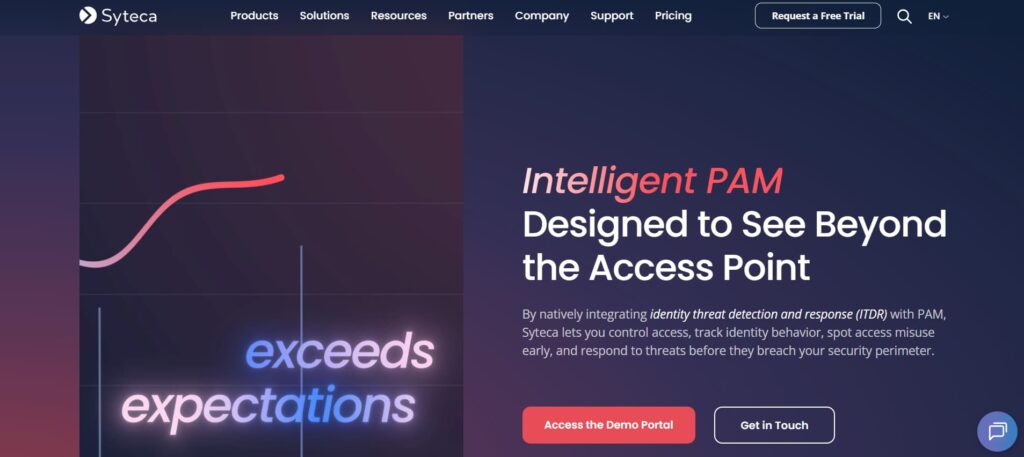
Syteca is a PAM platform founded in 2013 that uses session intelligence and built-in ITDR to monitor, detect, and respond to privileged access risks in real time. Unlike platforms that add threat detection as an afterthought, Syteca runs ITDR on session metadata rather than post-hoc log correlation. This design enables organizations to detect access misuse without delay while maintaining privacy-by-design principles.
The platform provides credential vaulting, automated account discovery, just-in-time (JIT) access provisioning, access approval workflows, multi-factor authentication, privileged elevation management, and workforce password management.
Session recording captures video plus metadata, keystroke logging, application tracking, and file transfer monitoring. Real-time rule-based alerts trigger automated incident response, including session blocking and user lockout.
| Feature | Implementation |
| Deployment speed | Hours, no professional services |
| ITDR approach | Session intelligence, not log correlation |
| Architecture | Cloud, hybrid, on-prem flexibility |
| Compliance support | GDPR, HIPAA, PCI DSS, NIST 800-53, ISO 27001 |
Notable customers include Visa, Samsung, UPS, Panasonic, Accenture, United States Department of Defense, Turkish Airlines, and Central Bank of Montenegro.
The platform was included in the 2024 KuppingerCole Leadership Compass for Privileged Access Management and the Gartner 2025 Market Guide for Insider Risk Management Solutions.
ARCON
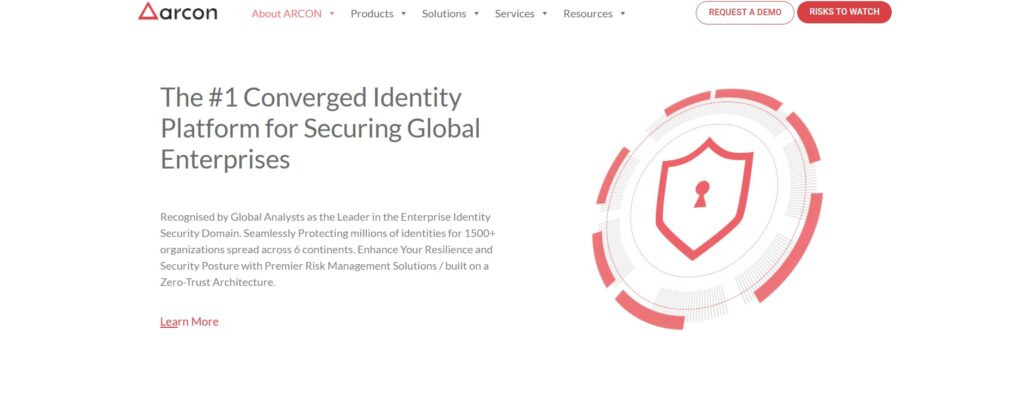
ARCON presents itself as an Identity-As-A-Service provider that emphasizes Just-in-Time access and strong session management. The platform is designed to protect business and infrastructure assets across hybrid environments from both insider threats and third-party risks.
Founded in 2006, the company has gained solid recognition in the space, including positive results in the 2022 Gartner Critical Capabilities assessment.
Its solution covers PAM, IAM, endpoint privilege management (EPM), cloud governance (CIEM), and just-in-time controls. Session management is a particular strength, offering granular access suited for situations where contractors need temporary elevated permissions.
Key differentiators:
- Just-in-time access provisioning reduces standing privilege windows
- Converged identity platform eliminates tool sprawl
- Global deployment footprint with regional compliance support
- Granular session control for third-party vendor access
ARCON operates support lines in India, the United States, the United Kingdom, the UAE, Malaysia, and Saudi Arabia — signaling a true multinational service model rather than regional concentration.
Keeper Security
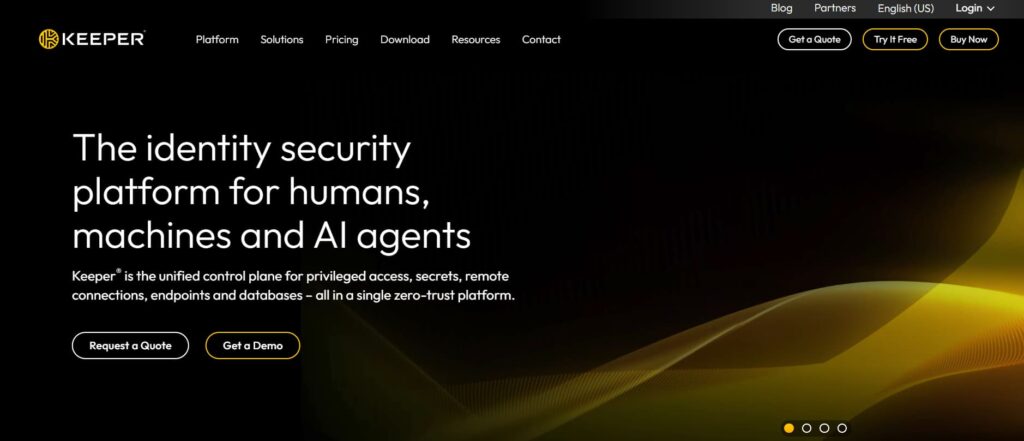
Keeper Security, founded in 1995, runs one of the oldest continuously operating platforms in the PAM space.
Rather than focusing only on privileged access, it serves as a unified control plane that brings together privileged accounts, secrets management, remote connections, endpoints, and databases — all inside a single zero-trust solution. This means the same console handles password vaults, SSH keys, API secrets, and database credentials.
The platform is built on end-to-end encryption and a true zero-knowledge architecture. As a result, only you can decrypt your data. Keeper’s team cannot access customer vaults — even if subpoenaed. That level of security matters a lot for organizations in healthcare, legal, and government sectors, where data sovereignty rules are strict.
| Deployment tier | Target audience | Key capability |
| Business Starter | 5-10 users | Encrypted vault + autofill |
| Business | Company-wide | Shared folders + delegated admin |
| Enterprise | Advanced provisioning | SCIM, AD/LDAP, SSO/SAML, RBAC |
The company operates offices with direct phone lines in the United States, Ireland, and Japan, indicating localized support rather than centralized call centers.
Fudo Security
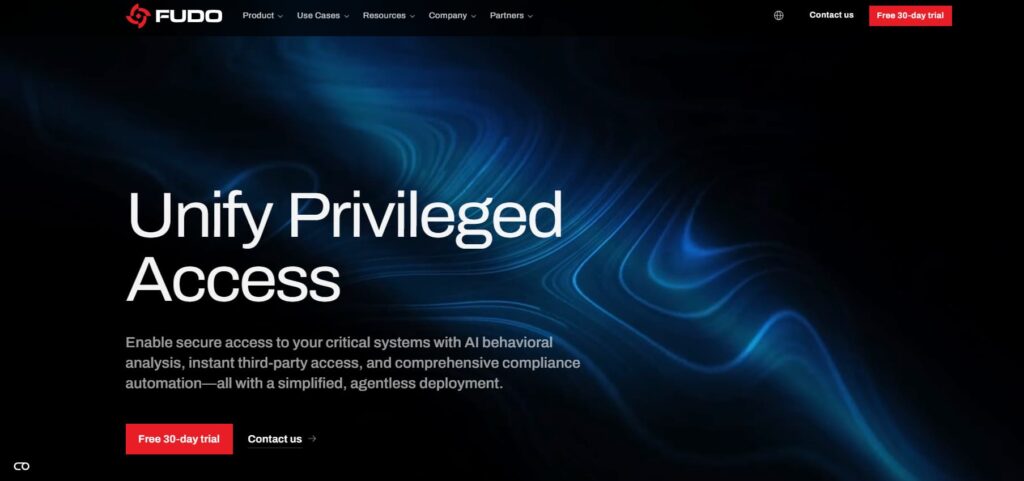
Fudo Security stood out early with its agentless approach. The platform gives you solid enterprise PAM features, including AI-driven behavioral analytics that track over 1,400 different user patterns, plus quick third-party access without needing VPNs or complicated setups.
Founded in 2012, the company built everything around a transparent proxy. User sessions pass through Fudo’s security layer without installing any software on endpoints.
Beyond that, Fudo delivers session recording, just-in-time access, credential management, real-time threat detection, and compliance tools. Its behavioral model learns normal patterns for each user and flags anything unusual that could point to compromised credentials or insider risks.
Core capabilities:
- 1,400+ behavioral features tracked per session
- Agentless architecture — no endpoint modifications required
- Just-in-time access workflows for vendor onboarding
- Automated password rotation with centralized credential management
Fudo operates support in Poland and the United States. Integration support includes Active Directory, LDAP, Windows Server RDP, Terminal Services Gateway, SSH key management systems, jump hosts, bastion servers, SIEM tools, and compliance reporting systems.
ManageEngine
ManageEngine treats PAM as just one piece of a much larger IT operations toolkit. As part of Zoho Corporation, it offers a wide range of solutions that help companies monitor, manage, and secure their environments.
Founded in 2002, the company now works with over 180,000 organizations in 190 countries.
Its product lineup is extensive: privileged access management, Active Directory and Microsoft 365 tools, MFA, SSO, SIEM, endpoint management, service desk, observability, analytics, and even low-code development.
Within that, the PAM360 platform concentrates on credential vaulting, privileged session management, access governance, and Zero Trust controls suited for complex enterprise setups.
Integration strengths:
- Native connectors to Active Directory and Microsoft 365
- SIEM correlation for privileged session data
- ITSM workflow automation for access requests
- Cloud-ready infrastructure support for hybrid environments
ManageEngine supports organizations across industries, including government, healthcare, finance, manufacturing, education, and retail. The platform emphasizes AI-powered IT management capabilities, cloud-ready infrastructure support, compliance-focused security tools, and scalable enterprise solutions for hybrid and multi-cloud environments.
Segura
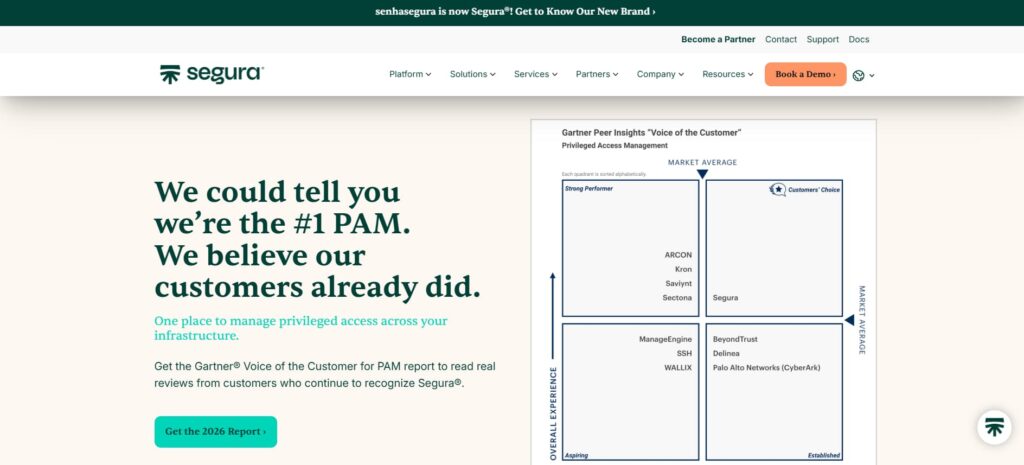
Segura (previously Senhasegura) rebranded to highlight its broader identity security capabilities. Since its founding in 2010, the company has stood out for transparent all-inclusive pricing and significantly lower total cost of ownership — often around 70% less than competitors. It’s also the top-rated PAM solution on Gartner Peer Insights.
Its platform includes PAM, endpoint privilege management, cloud IAM, CIEM, DevOps secrets, certificate management, and secure remote access. This allows organizations to consolidate privileged accounts, machine identities, cloud entitlements, and remote access into one solution.
The company serves customers across more than 70 countries and supports major compliance standards, including ISO 27001, PCI DSS, HIPAA, GDPR, and SOX.
| Deployment model | Key benefit | Support tier |
| SaaS | Automatic upgrades, all-inclusive pricing | Standard |
| Self-hosted | Datacenter or private cloud control | Customized 24/7 available |
Segura can be deployed in 7 minutes and can be deployed by internal staff without requiring professional services. The platform offers top-notch support focused on customer needs in multiple languages, with 98% willingness to recommend and a 5/5 rating on Gartner Peer Insights.
WALLIX
WALLIX stands out as a genuine European alternative to the big international cybersecurity vendors. Starting as a Paris startup in 2003, it has since developed into a mid-sized company and made history in 2015 as the first French cybersecurity firm to go public on the Paris Stock Exchange.
A big part of their approach is digital sovereignty — giving customers strong control over where their data lives to satisfy European rules.
The solution covers PAM, IDaaS, MFA, secure remote access, password vaulting, privilege elevation, and access governance. It’s built to help organizations meet key standards like GDPR, NIS2, DORA, and IEC 62443, particularly in critical infrastructure, banking, and government across Europe.
Compliance strengths:
- GDPR data residency controls
- NIS2 security requirements for critical infrastructure
- DORA operational resilience for financial services
- IEC 62443 industrial control system security
The company supports secure access management across industries such as healthcare, manufacturing, government, and critical infrastructure.
Delinea
Founded in 2021, Delinea represents a modern take on PAM. By combining with StrongDM’s just-in-time runtime authorization, it controls not only who can access systems but also what they can do during that access — all without permanent standing privileges.
Unlike traditional tools that open a session and leave it running, Delinea validates each command individually.
The solution includes privileged access management, identity posture analysis, credential vaulting, remote access, just-in-time controls, and governance features in a single ecosystem. With Delinea Iris AI, it delivers real-time identity discovery, adaptive authorization, and AI-powered auditing.
Technical differentiators:
- Just-in-time runtime authorization (validates per-command, not per-session)
- AI-driven identity posture analysis for risk scoring
- Zero standing privilege — access expires immediately post-task
- 500+ integrations with enterprise technologies
The company supports thousands of organizations worldwide and emphasizes scalable identity security for modern cloud, hybrid, and AI-driven infrastructures, helping businesses secure administrators, developers, workforce users, machines, and AI agents.
Frequently Asked Questions
Q: How much does enterprise PAM software cost in 2026?
A: Pricing varies by model and scale. Segura and Syteca emphasize transparent, all-inclusive pricing with lower TCO. SaaS deployments typically range from $50–150 per user annually for mid-sized organizations. Self-hosted perpetual licenses often start at $100K+.
Q: What’s the difference between PAM and ITDR?
A: PAM manages privileged access and credentials. ITDR provides real-time threat detection and response. Some solutions integrate both natively, while others require separate tools.
Q: Do I need agentless PAM?
A: Agentless deployment offers easier integration and fewer endpoint changes. Endpoint agents provide deeper visibility but increase complexity, especially in diverse or contractor-heavy environments.
Q: Which compliance frameworks are supported?
A: Top platforms support GDPR, HIPAA, PCI DSS, NIST 800-53, ISO 27001, FISMA, and NIS2. WALLIX and other European vendors excel in GDPR, NIS2, DORA, and IEC 62443.
Conclusion
Each of the eight platforms brings its own approach to privileged access management. From Syteca’s session-focused ITDR to Delinea’s runtime authorization, Segura’s transparent pricing, and WALLIX’s European compliance strengths.
Your best choice depends on speed (hours versus quarters), architecture preference, and the specific compliance rules you need to meet.
Skip the polished demos and ask for PoC access instead. Test the tools yourself on your actual infrastructure — especially with older jump hosts or isolated networks. And always talk to the implementation team, not sales, to get realistic deployment timelines before signing anything.