

API-first banking integration looks straightforward on paper — connect once, access thousands of banks. Reality differs. PSD2 compliance, real-time data freshness, payment initiation success rates, and geographic coverage all fragment across vendors.
Most platforms advertise “thousands of banks” but differ sharply on authentication flows, data enrichment depth, and whether they handle UK instant payments or European SEPA transfers.
We reviewed seven FCA-regulated Open Banking infrastructure providers using criteria that matter: documented API coverage, pricing transparency, and specialty depth in AIS vs PIS vs verification workflows.
Each serves a distinct use case — from scaling SaaS platforms needing white-label embedded finance to lenders requiring income verification APIs.
What Open Banking Infrastructure Platforms Do
Open Banking platforms link banks to apps that need account data or payment rails. PSD2 lets customers authorise third parties for AIS (account information) and PIS (payments) without sharing credentials. This enables secure instant bank transfers instead of card networks.
Main reasons businesses use them: faster onboarding, cheaper payments, real-time data for decisions, and embedded finance.
Providers range from payment specialists to data specialists to full-service platforms. The key issue is coverage quality. Many claim thousands of banks, but actual depth and reliability vary widely. Basic balance checks are common, but not all support recurring or complex payments.
Leading Open Banking API
Open banking providers now fall into three distinct categories: data aggregators, payment specialists, and enrichment layers.
Selecting the wrong category for your use case can add months of engineering work—so here are the platforms that lead each segment.
Finexer
Finexer is a UK-based, FCA-authorised Open Banking infrastructure provider built for scaling SaaS platforms, offering a B2B bank-to-bank technology solution focused on UK Open Banking connectivity, real-time financial data access, and payment workflows through a unified API infrastructure.
Founded in 2019, the firm combines bank transactional data, instant payments, batch payouts, and identity verification into a single unified API designed for faster deployment cycles.
The platform’s differentiator is 99% UK bank coverage with real-time, audit-ready financial data, making it a strong fit for UK-focused fintechs and vertical SaaS businesses embedding payment or verification workflows.
White-label customization supports custom HTML and CSS rendering, allowing platforms to maintain brand continuity through consent journeys — critical when onboarding customers inside your own product experience.
| Plan | Key features | Pricing model |
| Startup | Discounted pricing, white-label, unlimited accounts | Discounted pricing |
| Standard | Standard pricing, white-label, full feature access | Pay-as-you-go |
| Enterprise | Volume-based pricing, account management, migration assistance | Custom volume-based |
No setup fees, no hidden fees, no cancellation fees — transparent pricing structure uncommon in the category. The startup tier offers discounted pricing to start-ups that have no sales yet, lowering the barrier for early-stage platforms testing embedded finance hypotheses.
Salt Edge
Salt Edge focuses on global Open Banking coverage. It connects to 5,000+ banks in 50+ countries, helping companies access financial data worldwide without getting local licences everywhere.
Since 2013, it has built strong expertise in the space. The platform is backed by ISO 27001 certification and solid security standards.
Its main advantage is breadth. Salt Edge supports a wide range of local standards — from UK Open Banking and Berlin Group to CDR in Australia, Brazil, Saudi Arabia, and FDX in the US. This makes international expansion much simpler.
Useful features include:
- Multi-bank data aggregation.
- Payment initiation across borders.
- KYC and customer onboarding via bank data.
- Categorized feeds for personal finance tools.
- Unified views across multiple accounts and institutions.
It’s especially relevant for fintechs expanding into new markets or enterprises running operations in several countries.
Brite Payments
Brite runs a fast-growing instant payment network across 3,800+ European banks. It operates 24/7 with extremely low fraud and chargeback rates.
Founded in 2019, the company focuses on real-time settlement through its Instant Payments Network. Businesses can handle instant payments, payouts, account verification, and income insights.
It’s ideal for use cases that need money to move immediately — such as marketplace payouts, gaming withdrawals, and refunds. Compared to batch SEPA transfers, Brite confirms and completes transactions in seconds.
Operational advantages:
- 24/7 availability — no weekend or holiday blackout periods.
- Near-zero chargebacks — bank-authenticated payments eliminate card dispute fraud.
- Real-time settlement — funds reach recipient accounts instantly, not T+1 or T+2.
- No card network fees — direct bank-to-bank transfers bypass Visa/Mastercard interchange.
Brite AB is a licensed Payment Institution under the supervision of the Swedish Financial Supervisory Authority (Finansinspektionen). Brite AB provides payment services under the Swedish Payment Services Act (2010:751) and the PSD2. Swedish regulatory oversight plus PSD2 compliance enable passporting across EU member states.
The platform requires no app, registration, or manual input — consumers authenticate using local bank credentials, then authorize payment in a single flow.
Plaid
Plaid is the largest global Open Banking data network, built for enterprises and fintechs that need account linking and identity verification at scale.
Founded in 2013, it connects to 12,000+ institutions across 20 markets with over 100 million users. The platform supports account linking, payments, fraud tools, income verification, KYC/AML, and more.
It is PSD2 regulated with proper AIS and PIS licences in the UK and the Netherlands. This helps companies operate across borders without extra compliance complexity in each market. Plaid serves as a broad horizontal platform for lending, personal finance, payments, and business finance needs.
API products:
- Account linking — instant bank verification for onboarding.
- Identity verification — KYC/AML compliance workflows.
- Income verification — automated underwriting data.
- Transaction data — categorized spend analysis.
- Payments — account-to-account payment initiation.
Pricing starts with 200 live API calls per product on the free tier, scaling to unlimited live API calls with premium support, account management, and integration assistance on custom enterprise agreements. The free tier enables proof-of-concept testing without upfront commitment.
TrueLayer
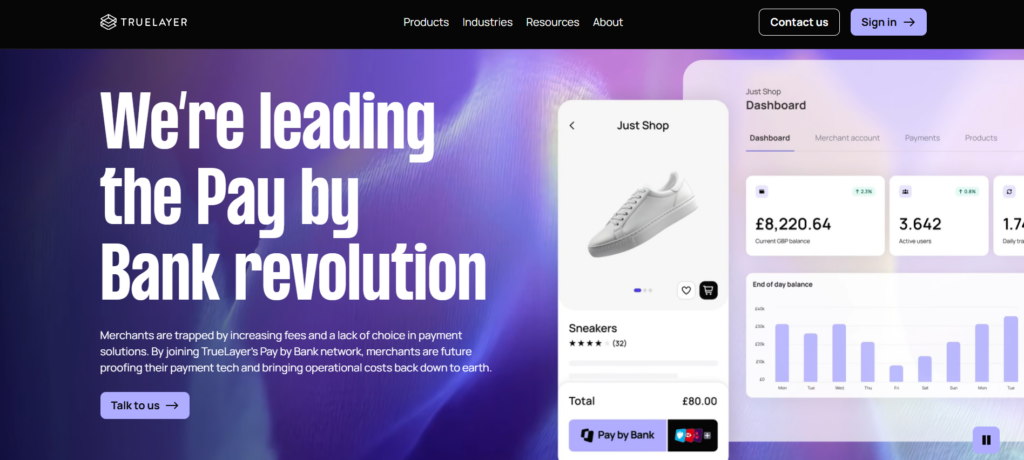
TrueLayer is the leading UK Pay by Bank infrastructure provider, handling almost half of all instant payment volume in the country. It’s especially effective for e-commerce and subscription checkouts that demand high conversion.
Founded in 2016 and FCA-regulated, it delivers instant payments, payouts, and financial data through one API. The company processes more than double the daily volume of its closest competitors and supports a network of over 20 million users, growing by 1 million monthly.
Key features include Pay by Bank, instant and verified payouts, recurring mandates, Bank on File, and Data APIs. This combination works well for businesses needing fast payments alongside verification and identity workflows.
Core capabilities:
- Pay by Bank — instant account-to-account payments bypassing card networks.
- Payouts — bulk disbursements to customer bank accounts.
- Bank on File — stored consent for recurring payments without re-authentication.
- Data API — transaction history and balance checks for onboarding/underwriting.
- Verification — identity and account ownership confirmation.
The company operates one of Europe’s largest Pay by Bank networks, supporting millions of consumers and processing billions in annual payment volume. This scale translates to higher payment authorization rates — critical when conversion drop-off directly impacts revenue.
Tink
Tink is a Visa-owned European Open Banking platform that offers access to over 3,000 banks via a single API. It simplifies cross-border data and payment work by removing the need for individual bank integrations.
Founded in 2012, it provides payment services, account verification, and data enrichment for fintechs, lenders, and banks. The platform handles account aggregation, payment initiation, income checks, risk insights, and customer onboarding across multiple use cases.
Tink is especially useful for standardising financial data and generating actionable insights for lending, e-commerce, and digital banking applications.
Pros:
- 3,000+ bank connections across Europe — broadest single-API coverage in the region.
- PSD2-compliant Open Banking services through cloud-based APIs and developer SDKs.
- 4 background refreshes every 24h for real-time data freshness.
Visa ownership (acquisition completed 2022) signals enterprise-grade infrastructure and long-term platform stability, but also introduces potential channel conflict for fintechs competing with Visa’s core payments business.
Bud Financial
Bud turns raw bank transaction data into usable, categorised insights for personalised banking and smarter credit decisions.
Since 2015, the company has specialised in data enrichment with 98% accuracy using AI and machine learning. While other providers focus on connecting to banks or moving money, Bud works on the intelligence layer sitting on top of that data.
Key capabilities include merchant categorisation, AI transaction search, customer segmentation, and credit risk tools. This helps build better spend insights and automated decisioning.
Bud is especially strong for:
- Digital banks building differentiated PFM tools.
- Lenders improving credit and income verification models.
- Embedded finance platforms adding financial insights into other products.
The high enrichment accuracy reduces mistakes that can otherwise affect credit scoring and customer experience.
How to Choose an Open Banking API Provider
Here’s what actually matters when selecting an Open Banking API provider:
- Geographic reach vs local depth: 12,000+ banks in 20 markets for global needs, or 99% UK coverage for local focus. Check real performance in your target banks.
- AIS or PIS strength: Match the provider’s specialty to your needs — data/verification or payments/recurring.
- Pricing model: Clear, fee-free structures are better for most. Volume pricing becomes key above 10k monthly transactions.
- White-label support: Customisable consent journeys are important for embedded SaaS experiences.
- Transaction enrichment: Look for 98%+ accuracy and detailed merchant tagging.
- Regulatory standing: Direct FCA authorisation, PSD2 compliance, and ISO 27001 matter for risk reduction.
Frequently Asked Questions
Q: Do I need my own PSD2 licence?
A: No. These platforms operate under their own licences, so you can use their authorisation instead of getting your own.
Q: How fresh is the bank data?
A: Real-time providers like TrueLayer and Finexer update on demand. Tink does multiple daily refreshes. Batch-focused ones update overnight. Always check for on-demand triggers if timing matters for your use case.
Q: Are there good options outside Europe?
A: Yes. Plaid covers the US and 20 markets total. Salt Edge reaches over 50 countries. Europe-focused platforms have more limited international coverage.
Q: Is white-labelling the consent journey possible?
A: It depends on the provider. Finexer gives the most flexibility with custom code. Most others only offer limited branding within hosted flows.
Conclusion
We ranked these Open Banking providers on documented coverage, regulatory strength, pricing transparency, and core specialty. All details were taken from official public sources only.
The right choice depends on your location focus, timeline, and whether you need strong payments or rich data. UK-only businesses should prioritise deep local coverage.
Get sandbox access early. Test real performance with your target banks before committing. This step matters more than brand names in this space.